From theory to practice through prototyping
The method for quickly turning ideas into physical forms and testing functionality
Commissioned by Didak Injection, Artori developed the Foldaway — a revolutionary, innovative, robust, user-friendly and sustainable plastic folding crate. Thanks to its unique design, the crate folds up to 20% more compactly than other crates on the professional market, while its maximum internal volume delivers the best volume-to-weight ratio.
In a series of articles, we highlight the journey from brief to finished product of this one-of-a-kind crate.
Today, we put theory into practice through prototyping.
From theory to practice through prototyping

The Foldaway folding crate now meets all client requirements — and those of the professional market — features a distinctive design, and, thanks to strength calculations, is the lightest folding crate on the professional market (1.8 kg). Now it was time to put theory into practice and bring the concept to life. Through rapid prototyping, we were able to quickly translate ideas into physical forms and test their functionality.
Scaled model or full sizee
By using 3D printing at a ½ scale, we were able to test the different models (600 × 400 mm and 300 × 400 mm). One of the key advantages of 3D printing is the ability to rapidly create prototypes with complex geometries, significantly shortening time to market. Needless to say, the handle is a critical component of a folding crate. To test its functionality, we also printed the crate at full scale.
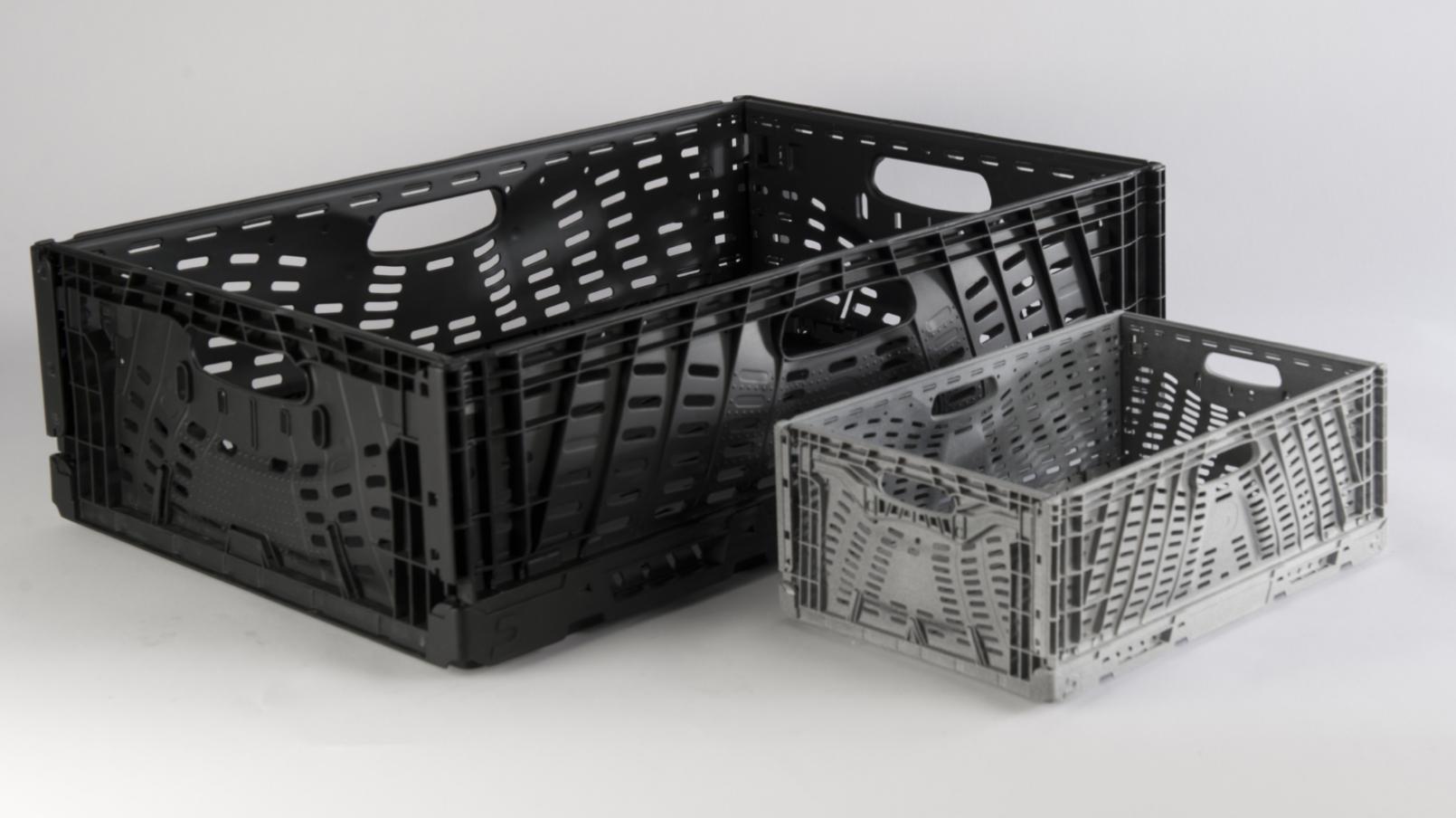
Castings
Using cast parts made with silicone moulds, we verified whether the overall design met the requirements of the final folding crates (stackability, interlocking, and more). For this, we worked with materials whose properties closely resemble those of the production material.
An added benefit is that these cast parts can already be used for marketing purposes, such as product presentations at trade fairs.

Related articles in this series
- Part 1: The Foldaway – Introduction
- Part 2: Benchmarking as a Driver for Innovation
- Part 3: Design Focused on Branding and Structural Strength
- Part 4: Strength Calculations for the Best Result
- Part 5: From Theory to Practice with Prototyping