Strength calculations, material selection and environmental impact
Strength calculations for the best possible result
Commissioned by Didak Injection, Artori developed the Foldaway — a revolutionary, innovative, robust, user-friendly and sustainable plastic folding crate. Thanks to its unique design, the crate folds up to 20% more compactly than other crates on the professional market, while its maximum internal volume delivers the best volume-to-weight ratio.
In a series of articles, we highlight the journey from brief to finished product of this one-of-a-kind crate.
Today, we explore how strength calculations help us achieve the best possible result.
Strength calculations, material selection and environmental impact
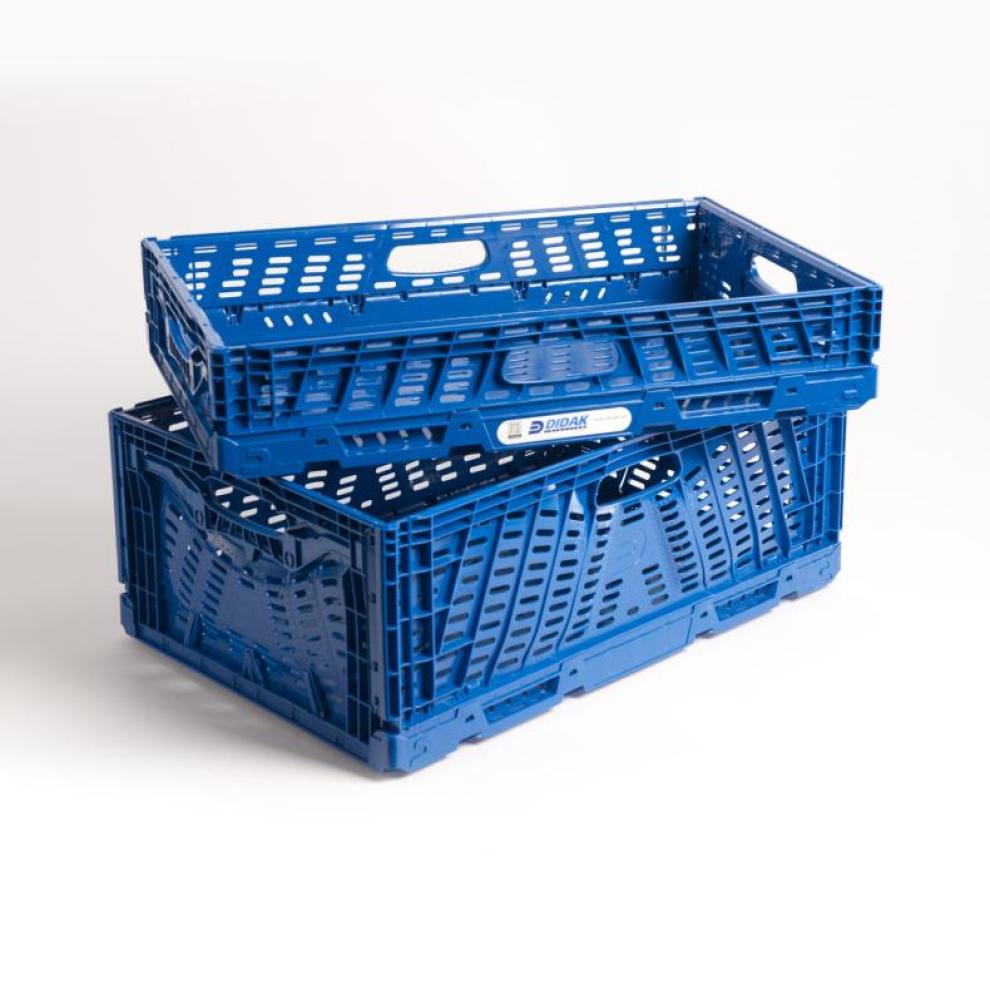
The Foldaway — Didak Injection’s revolutionary folding crate — is currently the only crate that meets three key requirements of the professional market, while featuring a design that not only enhances strength but also aligns with Didak’s visual language.
The next challenge: how do we ensure that a crate which folds up to 20% more compactly and offers the best volume-to-weight ratio can still carry 20 kg?
Welcome to the fascinating world of strength calculations.

A safe and reliable folding crate thanks to strength calculations.
The base of a crate plays a crucial role in supporting the weight of its contents — whether products, goods or raw materials. Strength calculations are essential to ensure that the designed product meets the required standards for strength and safety.
By varying parameters such as wall thickness during the engineering process and validating the effect of deflection through strength calculations, the design could be adjusted quickly and efficiently.
The material used for the crate is equally important in these calculations. We had to take material properties into account and ensure that the selected material delivered the required strength without adding unnecessary weight.
In addition, reinforcement structures play a key role. Smart solutions such as ribs or reinforcing edges improve the strength of the base without compromising weight or increasing production costs.
The result? The lightest crate with a 20 kg load capacity
By focusing on the minimum required wall thickness, we achieved the lightest crate on the professional market — just 1.8 kg — while still supporting a load of 20 kg.
This means fewer raw materials are needed to produce each crate. Add to that the fact that more crates can be transported per truck and that production runs on 100% green energy, and it’s clear that the Foldaway contributes to a more sustainable future.
Next week: prototyping.
Time to put theory into practice and bring the concept to life. Thanks to rapid prototyping, we were able to quickly turn ideas into physical forms and test their functionality.
You’ll read all about it next week.

Related articles in this series
- Part 1: The Foldaway – Introduction
- Part 2: Benchmarking as a Driver for Innovation
- Part 3: Design Focused on Branding and Structural Strength
- Part 4: Strength Calculations for the Best Result
- Part 5: From Theory to Practice with Prototyping
Do you have a great idea you’d like to turn into a product and are you looking for a partner who takes the pressure off?
At Artori, we’re happy to guide you through the entire journey — from product scan and design to engineering. Trust us with your idea and discover what we can achieve together.